
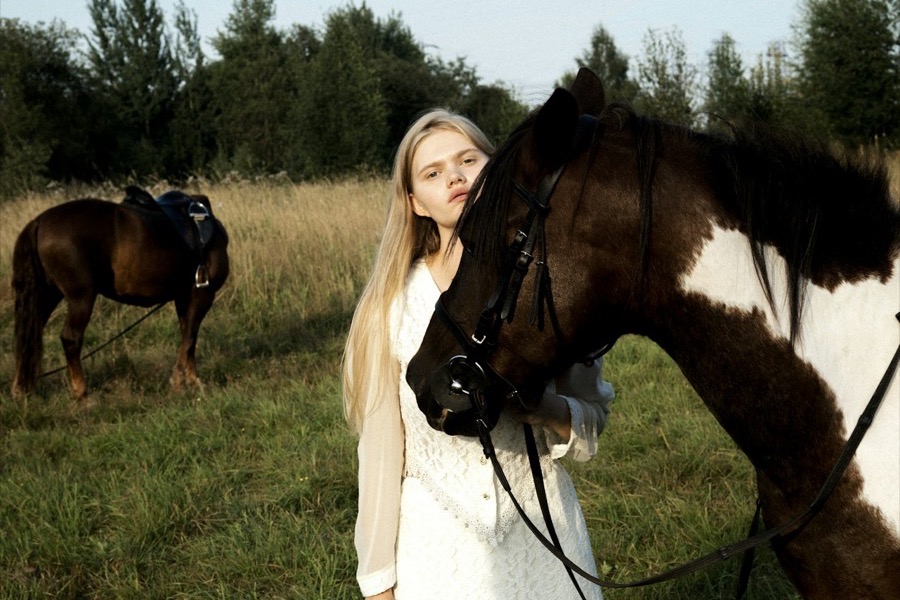

There is a kind of elegance that does not announce itself. It arrives in the proportions of a bag, the curve of a shoe, the cut of a coat, and it is only when you know where to look that you see the stable behind it all.

Hermès began not with silk or perfume but with leather and horse hair, in a workshop on the Rue Basse-du-Rempart in Paris in 1837. Thierry Hermès made harnesses and bridles. The saddle stitch he perfected, two needles through one hole so that each thread holds the other, still runs through every bag the house produces today. The Kelly was originally called the Haut à Courroies, designed to carry saddles and riding boots. The carriage and groom on the logo have never been replaced. There was no need.
Gucci made its debt visible. The horsebit loafer, introduced in 1953, places the metal fitting of an equestrian bridle across the instep of a shoe. The green and red stripe running through the house’s canvas came from the webbing used to secure a saddle. These were not references or homages. They were origins, carried forward because the shapes were already perfect.

Chanel arrived at simplicity through a stable. Gabrielle Chanel spent formative years at Royallieu, the estate of racehorse breeder Étienne Balsan, where she borrowed clothes from the grooms and understood that jersey, previously used for horse blankets, could transform women’s dressing entirely. The removal of the corset, the preference for ease and movement: those ideas were formed in a paddock.
Ralph Lauren named his company after the sport. The polo player on horseback is not merely a logo. It is a declaration of the world the brand was built around: country houses, riding weekends, the ease of someone who has never needed to try.

Burberry dressed the cavalry. The gabardine coat Thomas Burberry patented in 1888 was cut for officers on horseback. The D-rings, the storm flap, the proportions of the trench coat still carry that memory.
What the horse gave fashion was not style. It was standards. Leather that lasts. Stitching that holds. Hardware built to function. The equestrian world demanded permanence, and the houses that grew from it carried that demand into everything they made.
The horse did not inspire luxury. In many ways, it created it.